What makes a farm dam worth the effort?
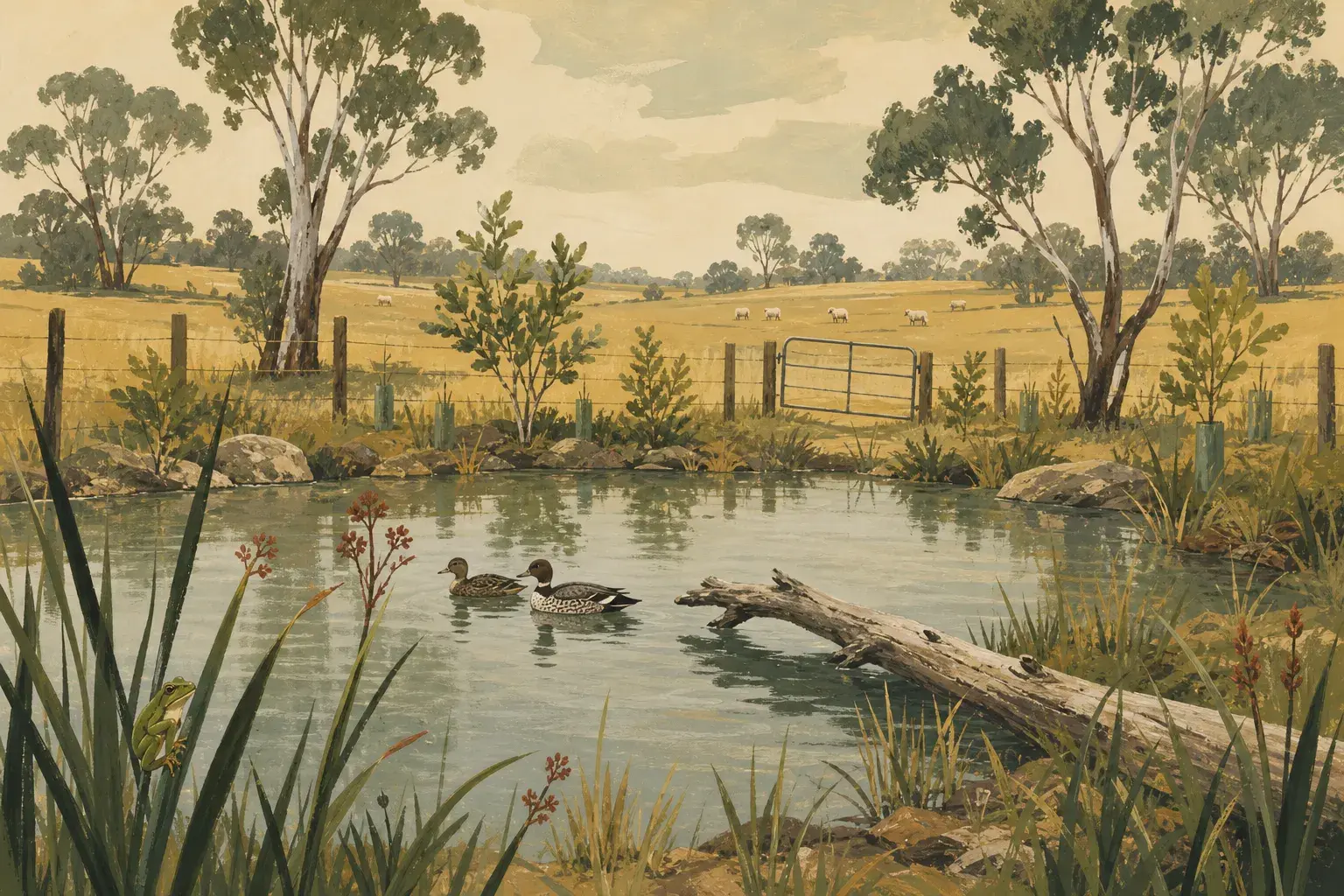
Most dams start as a hole for stock water. With constant stock access they end up with pugged edges, bare banks and poorer water.5 An enhanced dam is the same hole with stock access managed by a fence, a grassy buffer allowed to return, and native plants in and around the water.5
The wildlife response is well measured. ANU's Sustainable Farms team monitored 120 dams across NSW and Victoria, comparing open dams with fenced and revegetated ones. The enhanced dams had a significantly higher diversity of birds, frogs and aquatic insects and other waterbugs, and woodland birds showed more breeding behaviour around them than in other plantings.2
Frogs are the clearest local story. Surveys at 85 dams in the South West Slopes found significantly more frogs at enhanced dams than at control dams. That is a region where over 80% of the woody vegetation has been cleared, so a good dam can be one of the few wet refuges left.3
How does it help the water and your stock?
Stock wade in, stir up sediment and foul the water. Fence them out and the water starts to clear.6 ANU researchers followed 109 dams on 34 farms for two and a half years. Dams with stock excluded and native plants back had lower phosphorus and nitrogen, and less grazing nearby meant less E. coli.1 That matters on any farm, because phosphorus drives the algal blooms that can poison livestock.1
A separate study of 64 dams on 17 farms put numbers on it. Fenced dams had 32% less dissolved nitrogen, 39% less dissolved phosphorus and 22% more dissolved oxygen than unfenced dams, plus 56% lower diffusive methane emissions.4 Landcare Tasmania's 2026 booklet quotes further research showing 65% lower turbidity and 60 to 70% fewer faecal bacteria at enhanced dams.5
There is a water security angle as well. Evaporation is the main way a dam loses water, and well-placed plantings cut sun and wind on the surface.2
How do you lay out the fence, trough and plants?
Draw a mud-map first: fence line, gate, poly pipe, troughs, pump, tank, and the wet and dry zones.6 Then work through the site.
- Margin. Ideally at least 10 m from the high waterline. Make it bigger on the uphill side to catch soil and nutrients.6
- What to take in. Old trees, living or dead, seasonally wet ground and drainage lines all belong inside the fence.6
- Gate. Put one in for pump access, weed control and firefighting gear.6
- Stock water. Pump to a trough where you can. Otherwise build a fenced track with a gravel base to the water's edge.6
- Wire. Leave barbed wire out. Gliders and small possums tangle in it easily, and fences around dams are a known hotspot.68
- Plants. Start with about 1 plant per metre at or just below the high waterline for aquatics. In shrub zones, make trees only about 10% of the plants, and space trees 20 to 30 m apart.6
- Timing. Order before Christmas for autumn to spring planting, and put aquatics in when the dam is low.6
- Logs. Run timber from the water up onto dry land. Birds perch on it and frogs use it to get in and out. Tie it down with star pickets or wire so it does not float away.6
- Nest boxes. Natural hollows can take over 80 years to form, so boxes help where there are no old trees.6
Keep trees and big shrubs off the dam wall, because roots damage it.6 Earthworks such as shallow shelves and islands are specialist jobs, so get advice before you hire a machine.6
What does it cost, and who pays?
Cost depends on metres of fence, the pump and trough, and how many plants you buy, so we will not quote a figure that would not fit your block. The research does give a sense of value. A Sustainable Farms cost-benefit analysis of enhancing all the dams on a farm found a 70% probability that benefits would exceed costs, counting only modest cattle weight gains and reduced siltation.2
Paying for it is the sticking point. An RMIT study of more than 500 south-eastern farmers found about 80% would join a dam restoration program, with an average payment of around A$1,370 per dam per year needed for wide uptake.7 Your local Landcare group is the first place to ask about help with plants or planning.6
If you cannot fence every dam, rotational grazing still delivers some of the water quality gains.1