What is electric poultry netting?
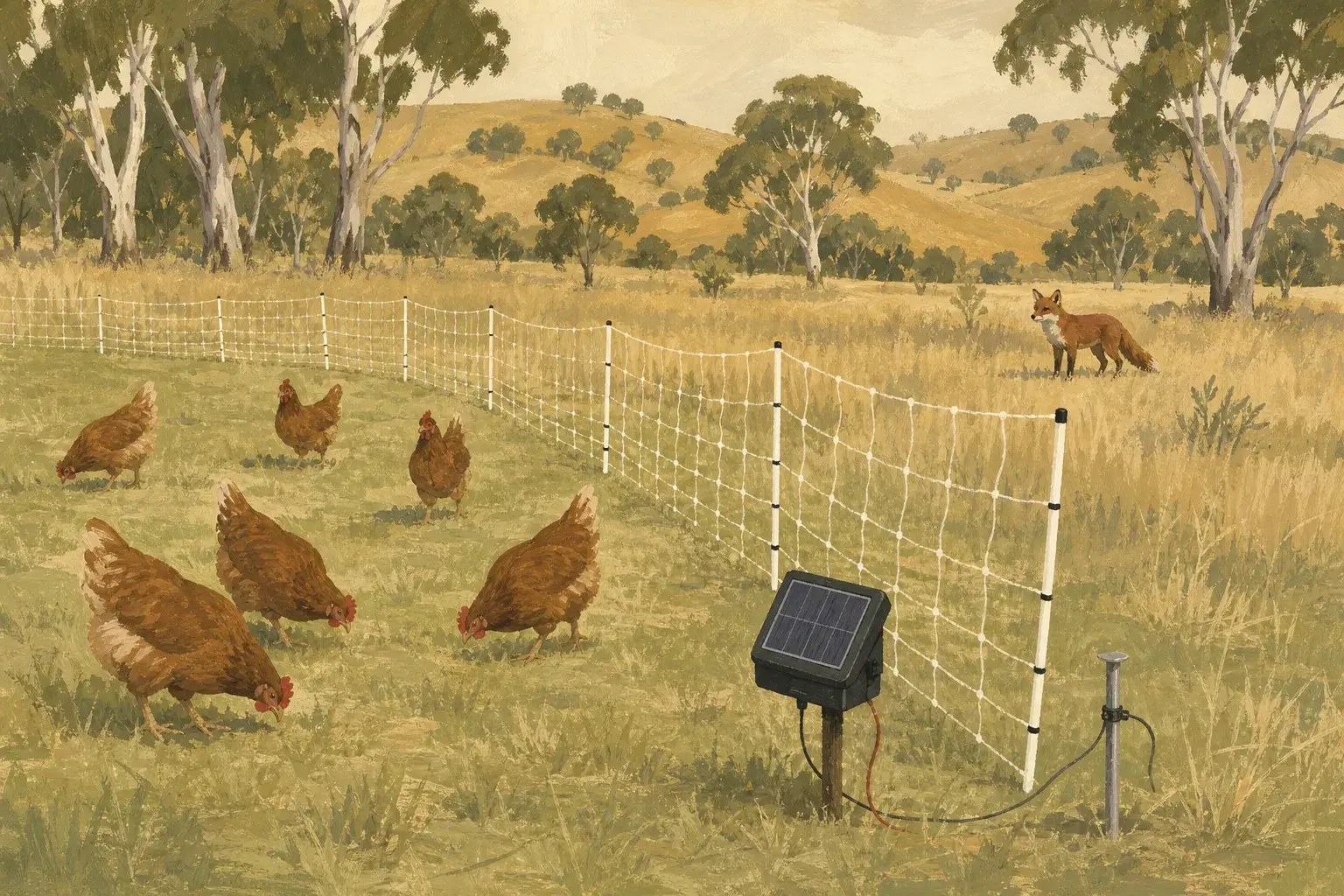
It is a portable mesh fence with fine conductive wires woven through it and posts built in. You run it from an energiser, and it comes as a kit with an earth stake, often in 50 m rolls.1 It is cheaper than a permanent fence, and you can move it to clean ground.1
The net's job is to teach. An animal touches it, gets a shock and backs off. That only works while the voltage stays up, and a flat net is just floppy plastic.
Be clear on what it will not do. PestSmart says electric wires are generally ineffective on their own, and it rates standard-height electric fences as cheap but not a complete barrier, best where the odd incursion is tolerable.3 Brisbane City Council warns that foxes are very adept at scaling fences, even electrified ones.4 So use netting for the daytime range, and rely on a fox-proof house after dark.
How do you choose the net and energiser?
Size the energiser first, because netting draws more than single-wire fencing. One Australian supplier's guide gives this rule of thumb.1
| Length of net | Suggested energiser |
|---|---|
| One 50 m net | 0.2 joule1 |
| Two nets | 0.5 joule |
| Three nets | 0.7 joule |
| Five nets | 1.5 joules |
The same guide says one 50 m roll needs an energiser rated to power at least 2.5 km, to stay under 2 joules so you do not burn the fine wires, and to use a separate energiser beyond five nets.1 Treat this as a supplier's guide and check the instructions for your own kit.
Height matters too. Foxes can clear a standard 900 mm fence, so compare the net's stated height with that number and buy the taller option if you have a choice.3
Then choose your power. Mains suits a yard close to the shed. A solar unit suits the back paddock, as long as the panel faces the noon sun.2
How do you install it, step by step?
- Prepare the line. Flatten or mow, especially anything over 10 cm tall. Driving a vehicle along the line marks it clearly.1
- Lay it out. Unfold the net in pleats along the line. Never roll it up like a carpet.1
- Set the posts. Put the first post at your access point and bring the last post back beside it. Push each post in firmly and keep each section taut.1
- Brace the corners. Add an extra stake where the net sags, and check for lumps and hollows where an animal could get under.1
- Earth it. Drive the stake at least 1 m into moist subsoil.1 Keep it at least 10 m from any other earthing system, such as the house power or phone earth.2
- Power up and test. Clip on, switch on and use a fence tester. Look for 3,000 volts or more.1 Dry ground and poor earthing are common reasons for a weak shock.1
- Sign it. Any part along a public road or pathway needs warning signs of at least 100 mm by 200 mm, yellow on both sides, with black lettering at least 25 mm high.2
How do you keep wildlife and people safe?
Australian installation instructions say electric fence constructions likely to entangle animals or people must be avoided, and that barbed wire must never be electrified.2 The fox fencing guidance also warns that some designs can entangle or electrocute animals you never meant to stop.6
Echidnas are the clearest local case. Tasmanian guidance says they can get caught in electric fences and die, and it recommends a first live wire at least 250 mm off the ground.5 Most poultry netting will not meet that, because its live wires start lower down. So keep nets away from known wildlife paths, keep the power on, and walk the line daily.
For people, the rule is simple: fences are not toys, so keep children off them and sign anywhere the public can reach.2
What does it cost, and is it worth it?
Prices change often, so we have not quoted one here. Ask your rural supplier to price the kit as a whole: net, energiser, earth stake and a tester. The tester is not optional, since it is the only way to know the net is working.
Compare that with a permanent fox fence. Fox designs often go to 1,800 mm with an apron or overhang, and every extra feature adds cost.3 Netting wins where you want to move hens around, or where a permanent fence does not make sense. It loses if you cannot walk it daily.