What is a wombat gate?
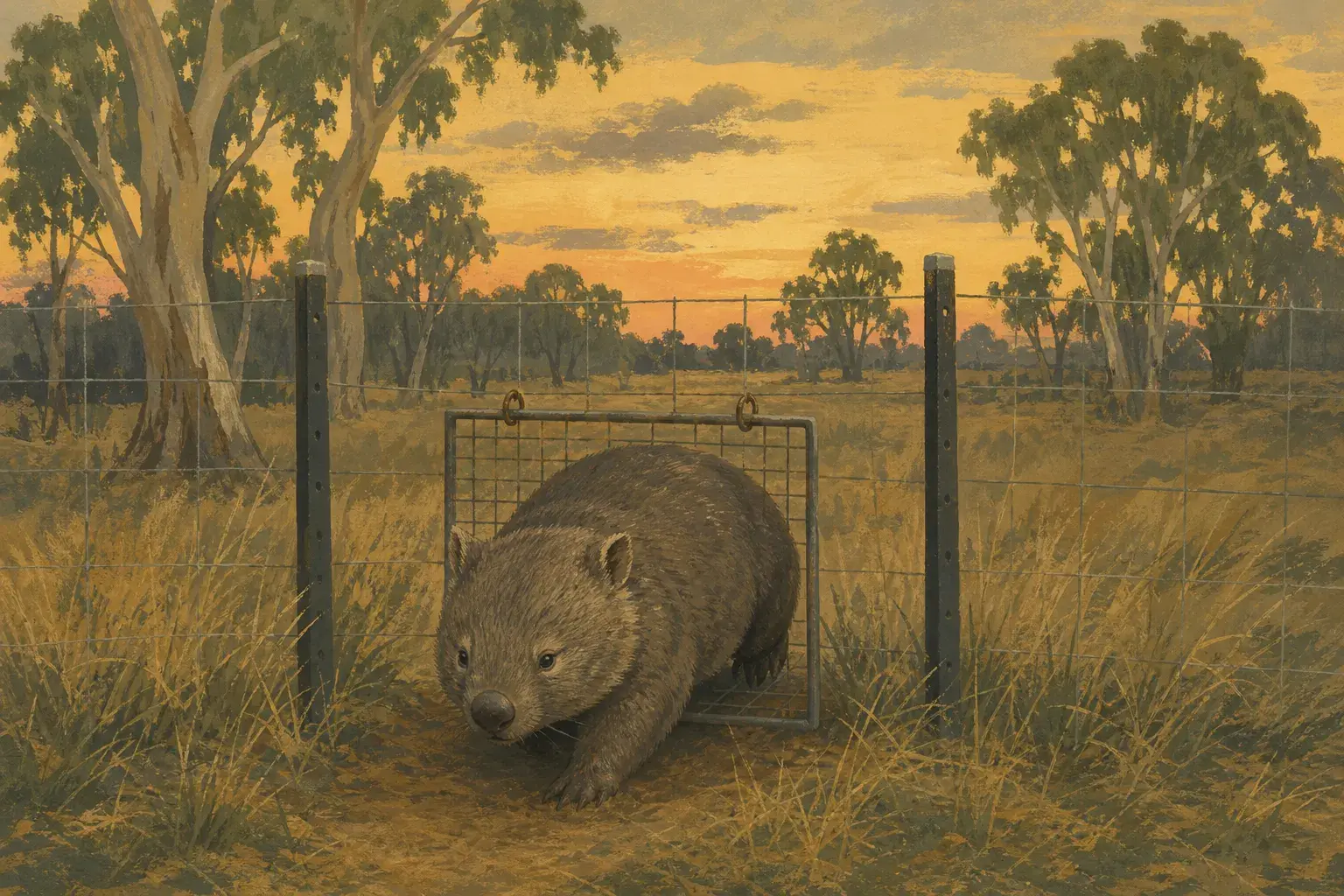
It is a small flap, hung from its top edge, set into a fence exactly where a wombat is already going through. The wombat pushes it open and it swings shut behind.
The reason to bother is simple. Wombats stick to the same path, dig under whatever is in the way, and leave a hole that wallabies then use. Block it and they dig again right beside it.2 Victorian guidance frames the gate as the long-term alternative to endless repairs: you do not exclude the wombat, you give it a path only it can use.1
There is a legal side too. In Victoria the common wombat is protected under the Wildlife Act 1975, and lethal control needs an authority that is only issued once practical non-lethal options are exhausted. DEECA does not recommend it for fence damage, because removing an adult just opens the territory to a younger wombat.1 Rules differ by state, so check yours. This is general information, not legal advice.
Does a wombat gate actually work?
The evidence is unusually good for a shed-built fix.
- On a Tasmanian grazing property, camera traps at 17 gates logged 633 wombat passes in two weeks, against 33 pademelon passes and 4 red-necked wallaby passes. The authors found gates also cut fence damage.4
- Game Services Tasmania checked gates with motion-sensing cameras: in 50 observations of wallabies approaching, none went through.7
- At a 22-hectare blueberry orchard in south-eastern Australia, six gates were tested for 10 months. Wombats got used to them within a month, while the gates kept excluding foxes and wallabies.5
- On a predator fence, 10 gates still worked after more than 10 years. Wombats and echidnas passed often, while foxes and black wallabies appeared unable or unwilling.6
Wallabies mostly do not notice the gate.3 Pademelons did get through at times, so treat it as a big reduction rather than a seal.4
How do you build and fit one?
Do these in order. The training matters as much as the steel.
- Let the wombat choose. Gates must sit on existing runways, not where it suits you.2 Pick two or three well-used holes and repair the others within a few hundred metres.1
- Train the route. Check and repair daily. After about a month they should be using only your chosen holes.1
- Make the flap. Use weldmesh so the wombat can see through it. In the Tasmanian trial, wombats ignored a solid gate and dug beside it, and lighter gates failed to stop wallabies. The best performer was 35 to 40 cm square with at least 3 kg on the bottom edge.2
- Make the frame. Steel star posts make a frame with no welding. An angle-iron frame needs no securing pegs and suits rocky ground.7
- Introduce it slowly. Put the frame up around the hole and leave it. Then hang the gate partly open so the wombat has to lift it a little. After another week or two, let it hang straight.1
- Keep it moving. Winter is the time to watch for gates blocked from opening or stuck open.2
Published sizes differ. Victoria describes a gate 60 cm wide and 90 cm tall,1 and the orchard trial used 0.6 m by 0.5 m gates of galvanised steel mesh.5 Follow your own state's guidance, and measure the wombat's hole before you cut anything. A long fence may need several gates, because wombats can enter at one point and leave at another.3
If you would rather stop digging altogether, Tasmania describes a hot wire 125 mm off the ground, or 200 mm where mesh with an apron is used.7 It needs a good energiser and vegetation control, and it can kill echidnas caught between the ground, the mesh and the wire.3
What does it cost, and who pays?
We found no published price for a gate. Materials are modest: a piece of weldmesh, two star posts, and a weight. Steel-post versions need no welding, so it is a home-shed job.7
The bigger comparison is the cost of doing nothing. Bega Valley farmers told their state MP in 2016 of losses running to tens of thousands of dollars in farm infrastructure, and one counted 100 burrows on his property. In the same report, the director of Potoroo Palace said the gate design had been in use for at least 20 years.9
There has been help, too. In 2022 the Wombat Protection Society of Australia was offering free gates to eligible landholders who agreed to give feedback, funded by a Victorian Government grant. The swinging gates, developed with the Berwick Men's Shed, can carry a mange treatment container.8 Check whether the offer is still running before you count on it.