What does free range actually mean?
On an egg carton it is a legal term. Hens must have meaningful, regular access to an outdoor range during daylight across the laying cycle, at a density of 10,000 hens or fewer per hectare, and that density has to be shown on the pack.3
That rule is for selling eggs. It says little about what suits ten hens on five acres. Do the sums and 10,000 hens per hectare leaves each bird 1 m² of range. The older Model Code guideline of 1,500 hens per hectare works out at about 6.7 m² per hen.2
For your own flock, the useful question is how much ground will stay alive under the birds you keep.
How much space does each hen need?
Start with the floor. The RSPCA's minimum floor or run area is 3 m² for up to six bantams or three large birds, and at least 0.4 m² for each extra large bird or 0.3 m² for each extra small bird. It stresses these are minimums and that bigger is better.1
So ten large hens need at least 5.8 m² of secure yard. Use that for a locked pen, not a range. At the Model Code figure, the same ten hens would have about 67 m² of range.2 On a small block we would treat that as the target to beat.
Do not expect everyone to use it all. An Australian trial tracked individual ISA Brown hens with radio tags across small flocks of 150 birds, at 2,000, 10,000 and 20,000 hens per hectare. By weeks 32 to 36, hens at the lowest density stayed outside longer each day. At that density 80.5% went out daily, and on average 38 to 48% of each flock was outside at once.2 These were experimental flocks, and the authors say more research is needed.
How do you stop the run turning to dirt?
Bare ground is more than an eyesore. Free-range hens face the highest risk of internal parasites because they pick them up from soil and insects.4 The RSPCA's list of fixes is short: spell and rotate paddocks or use mobile housing, keep drainage good, and keep hens off wet, muddy ground.4
The best on-farm test we found is Swiss, so take it as a lead rather than a local rule. Rotating paddocks reduced bare soil close to the house and significantly cut worm egg counts in droppings, although worm burdens at the end of lay did not differ significantly. The authors recommend rotation plus a small, permanently used all-weather run covered with wood chips or gravel.5
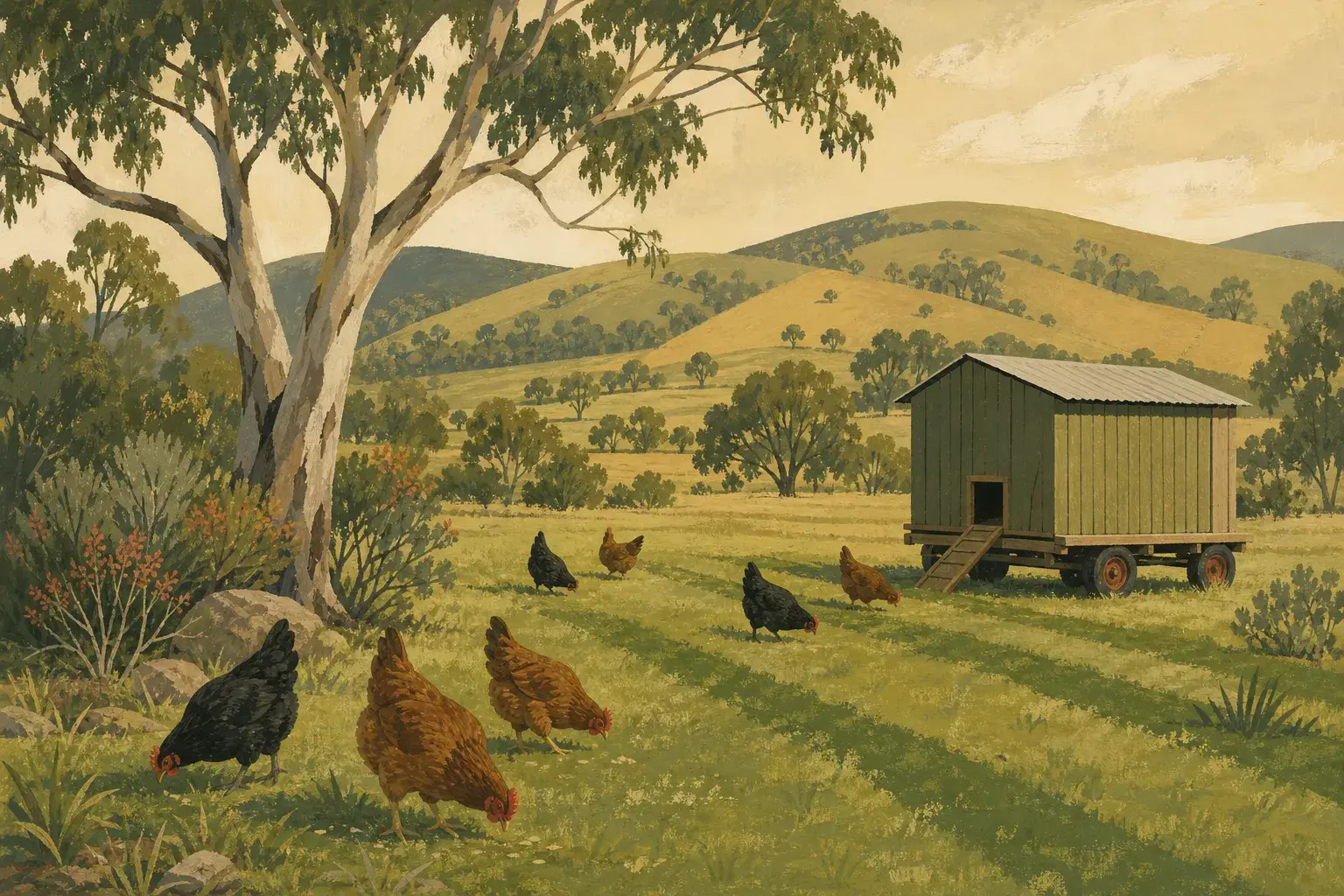
That gives a simple DIY layout. Build one hard-wearing yard at the pop hole, then run two or three pasture cells off it, each with its own gate. Open one cell at a time and close it before it goes bare. There is no official Australian rest period, so watch the grass. In summer, put shade in every cell, not just near the house.
How do you keep foxes out of the run?
Plan for jumping, climbing and digging. PestSmart says foxes can jump a standard 900 mm fence, and many fox designs double that to 1,800 mm or add an outward overhang.6 Use 40 to 50 mm hexagonal netting, with wire thicker than 0.9 mm, because foxes can chew through that gauge.6
To stop digging, bury the netting at least 450 mm, or lay an outward apron of 300 to 600 mm across the ground and peg it down.6 Small pens can take a full netting roof.6
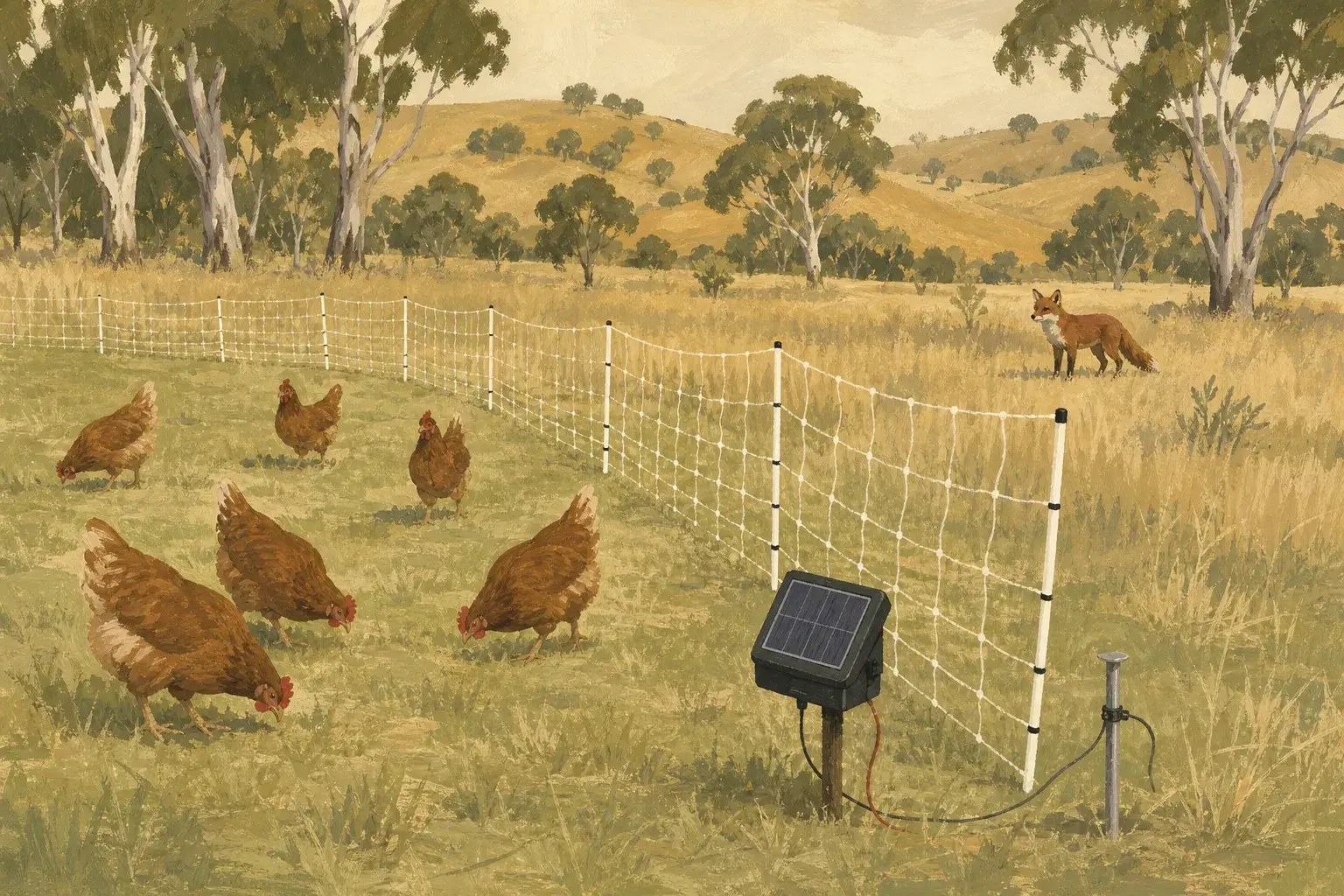
The house is your last line. It should be fully enclosed with a fox-proof door, roof and floor, and the birds need to be shut in at night when foxes are most active.7 The RSPCA adds a weekly check of the perimeter for damage.9 For a big range that cannot be fenced this way, look at electric poultry netting.
What does a good run cost?
A fixed run is mostly netting, posts and your time, so price it by the metre at your local rural supplier. The cost rises with height and with extras such as an overhang.6
Mobile coops are the other route. In 2022, Chicken Caravans was reported to be charging A$3,300 for a 10-chook caravan and about A$35,000 for a 600-bird model.10 Those prices are dated, but they show the range. For most smallholders, a home-built coop on skids or wheels moved by hand does the same job at the small end.